Lions and tigers and...cougars? Oh, my.
I spent the weekend at yet another conference, and this one included a Saturday afternoon field trip. There were three field trip options, and I chose a visit to the
Exotic Feline Rescue Center. How could I not? About halfway through the visit, I realized yet again that my life? It's sort of awesome. For real, though...how many people go on a trip for work and then end up spending their Saturday afternoon with giant cats?
With over 190 exotic felines calling the EFRC home, we are one of the largest rescue centers in the United States for abused, unwanted and neglected exotic felines. Our mission is simple: We provide permanent homes for exotic felines that have been abused, abandoned or for some reason have nowhere to live out their lives, while educating the public about these beautiful cats.
>> We do not buy or sell cats;
>> We give big cats a home for life;
>> We provide stable social groups;
>> We provide enhanced environments;
>> We provide the best veterinary care.
The EFRC was really great, though there were many sad stories to be told. It was obvious that our guide, Jean, truly loves her furry charges. I wasn't really surprised at how big some of the big cats are, but rather at how small the
cougars (a.k.a. pumas*, mountain lions, Florida panthers, catamounts) are. Granted, these guys didn't have the most luxurious lives before coming to the EFRC, so it's not likely that they'd top the growth charts. Cougars are officially members of the
Felinae (small cat) subfamily, along with cheetahs. But still, they were a lot smaller than I expected. Here's the quite petite Autumn, receiving scritches from the also somewhat petite Jean (she's probably about 5'3"):

Cougars can purr, and Autumn did. It's probably a good thing they had this posted at the entrance, because I wanted so badly to give her a tummy rub:

 I think this is Leroy.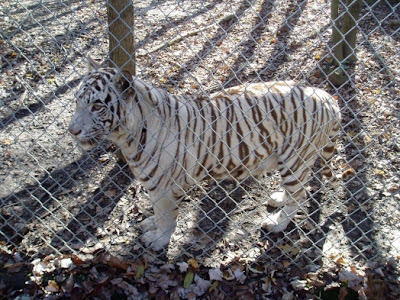
This dainty lady is
India. According to Jean, white tigers don't occur naturally in the wild. I don't know if this is true, but I have no problem believing that most white tigers seen in shows were produced by selectively inbreeding for a recessive gene. Predictably, the inbreeding can cause genetic problems. India suffers from retinal detachment and is blind. When we first arrived at her pen, she was walking very carefully across the ground, feeling each step out carefully with her paw before committing. But when Jean called her name, India trotted straight to the fence for some loving:


Meet Max & Kisa. Max was rescued from a breeder trying to produce white tigers. Unfortunately, Max's white brother was allowed to stay with the breeder. Another of the breeder's tigers is in a
rescue facility in Florida. This photo doesn't show how freakin' BIG Max is. Jean estimated he'll probably weigh about 800 pounds by the time he's done growing, and most of the other tigers we met were in the 500-600 pound range.
Kisa is a little bitty lioness who clearly loves Jean SO MUCH. Kisa has some neurological problems that left her with really bad balance, but it seems she and Max are good buddies despite her disability and their vast size difference. After Jean moved on, Kisa stayed by the fence, radiating hope that Jean would come back for more pets. It was very, very hard not to give her the ear rubs she so desperately wanted.
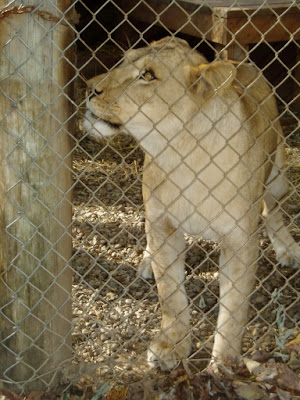
Even the tamest of the EFRC's cats can be dangerous, simply because of their size. Jean said that often when she comes to visit Max & Kisa, Max will gallop across the pen and plaster himself against the fence. Not a great plan when you'll someday weigh 800 pounds and the object of your affection is a smallish human!
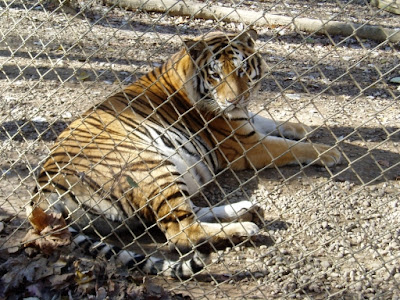
Some of the other cats were not as cuddly-looking as the fuzzies above. Even though these big fellas are quite fond of Jean and chuffed affectionately at her (kind of a gentle
rrrahhff sound), one of them was staring at a few members of our tour group through the fence and very obviously stalking them...just like a housecat would do, but backed by the spine-tingling certainty that this cat could eat us up if it wanted to:

But my God, they were gorgeous:


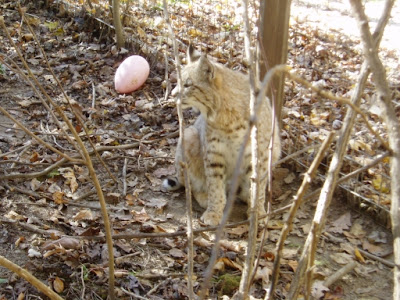
This dashing fellow is Lakota the
bobcat. He didn't pose very well for pictures, but at least he made an appearance. Jean said the EFRC's other bobcats, including the adorably-named Nickers, never come out until all the visitors are gone for the day.
Navi is a black leopard, and in the sun you can see the black spots on her black fur. Unfortunately, neither of them were very interested in getting a photo taken. I learned that there is actually no such thing as a black panther, only
melanistic (black-on-black) leopards and jaguars.
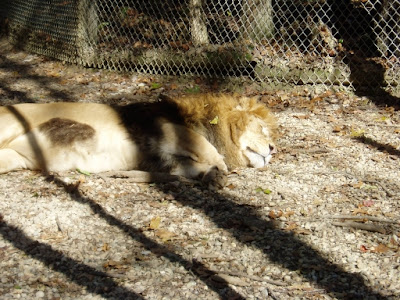
Lions sleep between 18 and 22 hours a day, as demonstrated by these lovely ladies:

When
King came to live at the EFRC, he was smaller than he should've been, so the caretakers didn't realize he was old enough to breed. He romanced his yard-mate,
Jasmine, and about 3 1/2 months later, Lauren was born. Now the whole family has been fixed (weird factoid: male lions can have vasectomies, but can't be fully neutered or they lose their manes), and they live happily together:

This guy got somewhat upset with us for staring at him while he was trying to eat. I guess I can't really blame him:

Just last week, I was thinking about the circus that comes to town every year, and wondering if I'd eventually take our kids to see it. When I was little, the circus was magical and sort of scary, but by the time I stopped going in high school, I was often sad for the animals. After visiting the EFRC, I don't know if I could stomach going to a circus again. As Jean pointed out, even the most conscientious circuses must take their cats on the road, and big cats just aren't meant to travel in small cages. Even so, I'm very glad I got to meet the various characters living at the EFRC, and I know their faces and stories will stay with me for a long time.
Weekend rating: wicked awesome
For more photos, visit
Shutterfly* What, like the shoe company?


